Showing posts with label Writing books. Show all posts

Friday, November 18, 2016

From the Inside . . . Out

By Kelly Bridgewater

Mostly everyone has heard of Susan May Warren in the book industry. She writes great books. Is the sweetest person to meet in person. I was lucky enough to sit down to coffee at the 2014 ACFW conference. Warren is totally approachable and doesn’t allow her writing stardom to go to her head. People at the book sales at the library or my local Christian bookstore are surprised when I tell them I have met Susan May Warren after I recommend her books to them. I have a picture on my phone of us having coffee at Starbucks in the hotel in St. Louis. Big fan moment for me too.
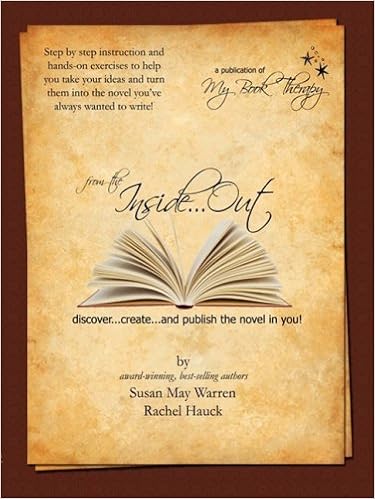
From Amazon

I have had her two books From the Inside. . . Out and Deep and Wide for quite a while now. I can’t honestly say that I have finished them because I found a gem that I need to work on, so then I find another book that talks about the same topic and jump to that book to see what they have to say on the same topic.

Since Warren is a published author, and I love her writing, I take what advice she can give pretty seriously. I follow her blog, which used to be called My Book Therapy, but now it’s called Learn to Write a Novel. I have a three inch binder where I have printed off articles from her blog and look at in addition to these books. Warren’s success rate is off the charts, so I wanted to find out what all the fuss was. I need to learn more on how to make my writing jump off the charts, so I bought these two books. I need to purchase The Book Buddy, which I haven’t gotten yet.

Warren helps you with everything from writing the synopsis to defining the Dark Moment in your character’s past. She explains it in an easy to understand format so that I think she is sitting right next to me offering me advice to, hopefully, someday give me a complete book that is ready for publication.

Do you enjoy getting writing advice from some of your favorite writers? Does it make you pay more attention to the words they have to say? Why?

Friday, November 4, 2016

Grammar for College Writing


By Kelly Bridgewater

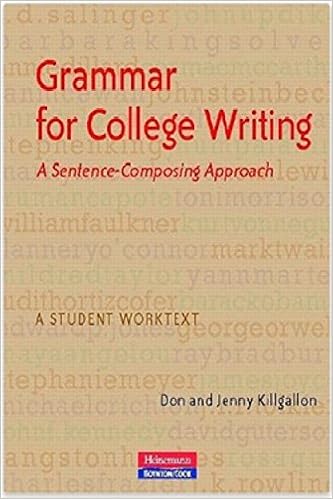
As writers, we are always looking for advice to make our writing jump off the page and into the reader’s imagination. The writing book I’m want to talk about this month is not a writing instruction or advice book where you will find information about plot twists, characters, or how to revise your book. I came across this in grad school when I wanted to figure out how to pump up my writing and make it more sophisticated. Grammar for College Writing by Don and Jenny Killgallon is a great resource for anyone who wants to improve their sentence writing ability.

From Amzon

How could a book that quotes J. K. Rowling, author of the famous Harry Potter series, who is a master at creating details with her sentences be bad? I knew that I loved the Harry Potter series, but I never actually focused on how she constructed her sentences. After doing the first section in Killgallon’s book, Noun Group: The Naming Tools, I was hooked.

They take simple grammatical words like appositives, gerunds, infinitive, and noun clauses and shows how to expand the sentences using these grammatical devices. She starts each section defining what each term means with at least three different examples from classic literature. Then the review section is usually pretty big. First, you will exchange sentences by switching up the infinitive or gerund with something closely grammatically related. Then you will practice expanding by adding an infinitive phrase or gerund phrase to the bold face section. There is matching. Multiple choices. More practice.

It really helped me to improve my sentences. While I was teaching college at Indiana State University in their English department, I would throw in some grammar on Fridays. Some of the exercises were from this book. I would start the exercise with taking apart one of Rowling’s well-written sentences and make it flow as a simple sentence: He ran. Sweat poured. Foot hurt. After putting the sentence back together, they learned how much better a variety of sentences in our writing can flow better. As much as I enjoyed improving my sentences, I believed my students didn’t like it, but I showed them how richer than writer can be by using these simple tricks.

This is a great book if you want to learn how to make your sentences have more variety. I also suggest looking at J. K. Rowlings famous series and observe how her sentences just flow off the page.

Do you enjoy learning how to grammatically better your sentences better? As a writer, grammar should be important to our lives as much as the creating of our stories.

Friday, October 21, 2016

Writing for the Soul


By Kelly Bridgewater

I saw Jerry B. Jenkins writing book advertised in the back of one of my fiction books, and I couldn’t wait to get my hand on the book. I have loved all of Jerry B. Jenkins Left Behind books and always wanted to take The Christian Writer’s Guild courses, but financially, I couldn’t afford it.


From Amazon
Writing for the Soul is a quick read that you could sit down and read straight through for a couple of hours. It really doesn’t throw anything at you that would require you to do exercises upon exercises. It grips your attention and comforts you. At the end of each chapter, there is a Q and A section where Jenkins answers questions.

The story reminds me of On Writing by Stephen King. It is part autobiographical plus part helpful hints. Jenkins allowed me to learn how he became a writer and moved up the ranks from writing tons of articles to publishing short stories to become a published writer of many books. He wanted to give back to the writing community because so much had been given to him. As the back cover states, “Jenkins shares the honest and straightforward truth about how to find writing success and why the journey is a continuous one.”

As I’m sure a lot of you here are like me, we have wanted to write for a while now and are always on the lookout for things to inspire and encourage us on this lonely road. We, including me, need encouragement from time to time. This journey can be tough and bumpy. Jenkins offers just that. Encouragement. Comfort. Tossed in a few tips with honest answers. Now you have Writing for the Soul. I pick up this book when I need a pick me up about my writing choice.

What book do you return to, besides the Bible, for encouragement about writing? Are there moments where you just want to quite? I have those about once a week, so you’re not alone.

Friday, September 16, 2016

Stein on Writing


By Kelly Bridgewater

Stein on Writing is one of my favorite writing instruction books. I first checked it out at the library, but I found I wanted to highlight a lot of things, so I had to purchase the book for myself. This book is different from a lot of writing instruction books because it is actually written by an editor. (I know; it has become a trend lately for editors to write instruction books, but in 1995, it wasn’t. I believe.) I really enjoyed getting down and paying attention to what Sol Stein had to instill in me. I want to become a better writer, so this book does exactly that.

From Amazon
From the first page in the first paragraph, Stein grips my attention. He says, “This is not a book of theory. It is a book of usable solutions—how to fix writing that is flawed, how to improve writing that is good, how to create interesting writing in the first place” (3). His book does exactly that. It teaches how to make the basic writer better and keep teaching those who have been published or who have been reading book after book for a while on how to be a better writer. The book doesn’t discriminate. There is something for everyone.


Stein has a huge chapter on creating interesting characters. You want to give a character a background that makes them interesting. Who really wants to read a story about a character that is good all the time and nothing bad happens to them? They don’t make bad choices. They marry the perfect guy and have the best behaved children. BORING!! So not real. Life has a bunch of bumps and bruises to it. So should your character. He breaks down tricks on how to breathe life into your character. What makes them stand out? What made Sherlock Holmes a household name? He solved crimes, but that isn’t the most rememberable characteristic of him. He was quirky and had social issues, but he was smart and saw things others didn’t see. Even the trained Scotland Yard officers. I want to create characters like that.

I really enjoyed the chapter entitled “How to Use All Six of Your Senses.” It is short, but there is a lot of information in those few pages that really help you draws the reader into the pages of your story. I’m still working on how to incorporate all six senses into my story. I have been studying Susan May Warren’s books to help improve my techniques on using my six senses since she is good at inviting her readers into their surroundings.

In conclusion, there is a lot of important information in Stein on Writing, that this blog post doesn’t do the book justice. Take my advice. It is a good book to have and read over a period of time to improve your writing.

Friday, May 20, 2016

Techniques of the Selling Writer

By Kelly Bridgewater

Like last month, when I discussed why I enjoy reading Scene and Structure by Jack M. Bickham, this month I will be discussing Dwight V. Swain’s book Techniques of the Selling Writer. This book is in the same format. Pretty dense to sit down and read in one sitting. It is not conversationalist like Stephen Kings’ and Steven James’, but I still find it really important to improve my writing.


From Amazon
One of my favorite sections in the book is entitled “Plain Facts about Feeling”. I really enjoyed reading this chapter. There is a lot to study. He explains motivations and reactions, then shows examples. Then jumps into a different way to look at it. Then he jumps into Sequence and Sequel. Shows examples. It is inspiring. My favorite quote in this section is “For a story is really never about something. Always it concerns, instead, someone’s reactions to what happens: his feelings, his emotions, his impulses, his dreams, his ambitions, his clashing drives, and inner conflicts. The external serves only to bring them into focus” (42). I don’t know about you but I never thought of looking at a story like that. I always thought the plot and what was happening externally is important, but it is more important to watch the character’s interaction with the tension.

Swain also talks about a number of different areas that writers need help on. There is the “Beginning, Middle, and End”, “The People in Your Story”, and “Preparation, Planning, and Production.” Luckily, you don’t have to read Swain’s book straight from front to back. You can pick and choose what you want to read. If you don’t really want to sit down in a comfy chair and read for hours, you can pick up the book and read a chapter once a week or whatever makes you comfortable. It took me about a month to finish the book. Not that it wasn’t interesting, but I needed to read and digest what I had read to see how I could use it in my next book.

Share something from this book if you have read it. What is your favorite part of a writing book? Let’s share some tips together.


Friday, April 22, 2016

Scene and Structure: Jack M. Bickham

By Kelly Bridgewater

In two past blog entries, I have included two of my favorite writing books. Story Trumps Structure by Steven James and On Writing by Stephen King. Today, I want to talk about a book that I am still working with on a daily basis and hopefully soon, I will master. Most writers do not enjoy mathematics in school or in daily life. But I’m an exception. I really enjoyed Algebra, Trigonometry, and Calculus. Besides reading in class, I loved figuring out math problems, not story problems; I can’t do those.
From Amazon

As a budding writer, I have a hard time understanding how a scene goes together. Why internal dialogue? Why do you need to know the other character’s facial and body expressions to understand the story? When reading, I understand it completely. But as the writer, I have a hard time including that in my writing. I create the emotions from the main character’s perspective for each scene, but the Stimulus-Internalization-Response sequence confuses me. I have a really hard time with Deep POV too. I have read and studied Jill Elizabeth Nelson’s book on the subject. But once I sit down to include it in my writing, it doesn’t happen.

In Scene and Structure, I have many, many underline parts and post-it notes. I have even done the exercises over and over. I have taken the exercises to Susan May Warren and Steven James’ books, trying to figure out how this works. The analytical side of my brain doesn’t comprehend how this flows together. As I enter contests, the biggest comment I receive from the judges is that I don’t do Deep POV well, but I can’t get my brain to understand this. I need someone to mentor me in this because I sure can’t understand this.

Anyways, Bickham includes weaving subplots into the main story line. He uses examples from popular literature. Even if you aren’t familiar with the story, you will be able to understand his examples.

Some writers may find this book to complex, but I really enjoy reading and studying this book. It is more detailed and explained than most writers probably want when reading a writer book to improve their craft. I just wish there was more like this.


Did you enjoy math in school? Have any suggestions or clues to help this Deep POV struggling writer to figure this out? I would gladly start a discussion on this and take advice.